Heritage
Muso Jikiden Hasegawa Eishin Ryu – Yamauchi-Ha
Muso Jikiden Hasegawa Eishin Ryu represents one of the most historically continuous traditions of Japanese iaijutsu and kenjutsu, tracing its origins to the late Sengoku period. The tradition is generally understood to descend from the teachings of Hayashizaki Jinsuke Shigenobu (c.1542–1621), who is widely regarded in historical literature as the originator of formalised techniques of sword drawing and immediate combative response. His teachings became the foundation for a number of iai traditions, including those that would later evolve into Muso Jikiden Hasegawa Eishin Ryu.
Following its early development, the lineage became closely associated with Tosa Province (present-day Kochi Prefecture in Shikoku) during the Edo period (1603–1868). Tosa was governed by the Yamauchi clan, a powerful daimyo family that maintained strong martial traditions among its retainers, and they were a major influence during the Meiji Restoration of 1868 – Sakamoto Ryoma as an example. Within this domain, sword training was preserved as part of the formal martial curriculum of Tosa warriors, resulting in the development of distinctive technical and pedagogical characteristics. The relative geographic and political isolation of Tosa contributed to the preservation of classical forms and transmission practices.
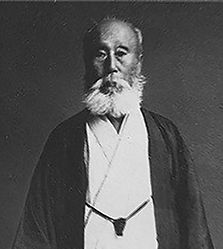
Oe Masaji
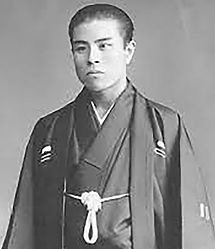
Yamauchi Toyotake
A major transformation of the school occurred under the 17th generation headmaster,
Oe Masaji (also known as Oe Masamichi, 1852–1927). Oe Sensei is recognised as a central figure in the modern codification of Muso Jikiden Hasegawa Eishin Ryu. During the late Meiji and Taisho periods, when Japan was undergoing rapid social and military reform,
Oe Sensei reorganised the technical syllabus, consolidating inherited teachings, and established a systematic curriculum that allowed for consistent transmission beyond the hereditary warrior classes. His work ensured the survival of the tradition during a period in which many classical martial systems declined or disappeared.
Among Oe Masaji’s prominent students was 18th generation master Yamauchi Toyotake (1903–1946), a viscount and member of the Yamauchi ruling lineage of Tosa. As the grandson of Yamauchi Yodo, the final daimyo of Tosa Domain, Yamauchi Toyotake received martial instruction consistent with his aristocratic warrior education. He was one of a small group of practitioners to receive the Iaijutsu Kongen no Maki, a scroll representing complete transmission of the tradition’s technical and philosophical teachings.
Yamauchi Toyotake also studied Yagyu Shinkage Ryu, a prominent classical kenjutsu tradition historically associated with the Tokugawa shogunate. His combined training contributed to the preservation of refined technical characteristics and formal composure within his transmission of Muso Jikiden Hasegawa Eishin Ryu. He is also noted for authoring Iai Shosetsu, an early written text documenting elements of the school’s teachings, reflecting a transition from exclusively oral transmission toward limited textual preservation during the early twentieth century.
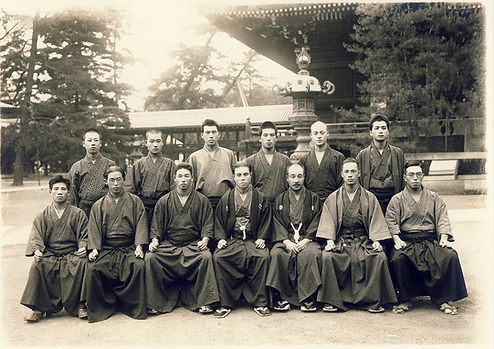
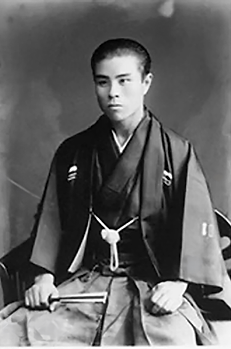
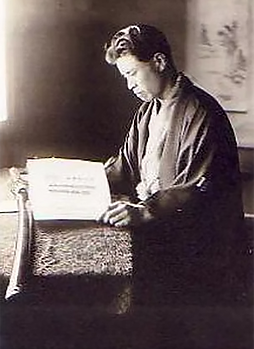
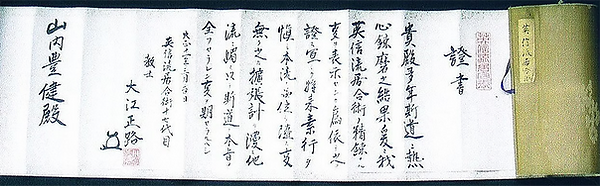
Part of Yamauchi Sensei's Kongen no Maki and above right, reviewing the certificate
The lineage continued through the 19th generation master, Kono Kanemitsu, a direct student of Yamauchi Toyotake. Kono Sensei played a significant role in the geographic expansion of the Tosa tradition by establishing the Meibukan Dojo in Toshima Ward, Tokyo. His efforts contributed to the continuation of classical iai instruction in urban Japan during the post-war period, when traditional martial arts were undergoing redefinition within modern budo organisations.
Leadership of the Meibukan lineage was subsequently inherited by the 20th generation headmaster, Onoue Masamitsu. Onoue Sensei maintained the preservation of the classical curriculum while supporting engagement with broader national martial arts structures, reflecting the evolving relationship between koryu traditions and modern federated budo practice.
The 21st generation transmission was represented by Honda Masayoshi Sensei (Jushin (1936–2022)), a direct student of Onoue Masamitsu Sensei. Honda Sensei received the Iaijutsu Kongen no Maki, signifying full transmission of the school. In addition to his koryu training, he achieved Kyoshi 7th Dan within the Zen Nihon Kendo Renmei (ZNKR). He also studied under Iwata Norikazu Sensei, founder of the Roshukai organisation and was based in Kochi Prefecture, which emphasised the preservation of traditional iai practice alongside broader budo development.
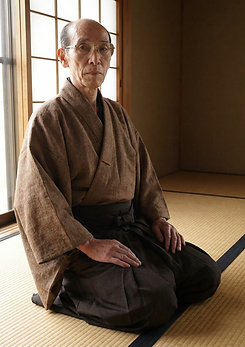
Onoue Masamitsu Sensei
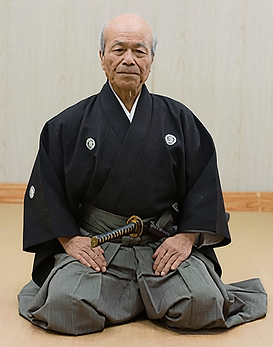
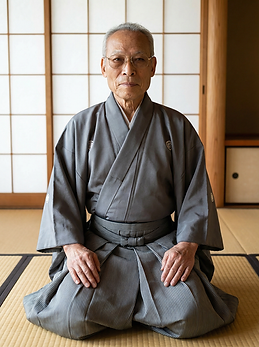
Iwata Norikazu Sensei
Honda Masayoshi Sensei
Honda Sensei dedicated more than five decades to the practice and instruction of iai and led
Tokyo Adachi Roshukai 蘆洲会 – based in Adachi-ku, Tokyo – for over thirty years. His teaching contributed to an international dissemination of the Tosa-based transmission of Muso Jikiden Hasegawa Eishin Ryu while maintaining adherence to classical training methodology.
In recognition of his contributions to the development and preservation of iai,
Honda Masayoshi Sensei was posthumously awarded a Kensho-jo, an official commendation from the Zen Nihon Kendo Renmei in 2023.
Honda Sensei has been succeeded by a 22nd generation practitioner and long time student,
Ishizako Sensei, and assisted by other senior students of Honda Sensei. They lead the group, and maintain the cultural, ethical and technical aspects of the study of Yamauchi-Ha iai and kenjutsu.
Today, this lineage continues through direct transmission within the Adachikai 蘆立会, preserving both the technical curriculum and cultural ethos inherited from earlier generations. The group’s leader spent over 20 years studying directly with, and under the guidance of Honda Sensei, and is now able to continue the study under Ishizako Sensei and other senior students based at the main dojo in Adachi-ku, Tokyo.
This continuity of Muso Jikiden Hasegawa Eishin Ryu reflects broader themes within
Japanese classical martial arts, including the integration of technical training, ethical cultivation and lineage-based preservation.
